Return to Roth IRA
Best Age for Converting to a Roth IRA
© Peter James Lingane, 5/1/98
Financial Security by Design
925.299.0472 or Fax 925.299.0473
e-mail: lingane@post.harvard.edu
Pension and other assets of a couple in the 28% federal tax bracket were forecast from age 45 and the wealth benefits on converting to a Roth IRA were calculated at periodic intervals. Benefits are substantial at all ages but are largest, in this example, when converting after retirement and before age seventy. It is necessary to convert increasing larger sums as one grows older to achieve the same absolute benefits. Benefits, and the conversion amount to achieve maximum benefits, are changed significantly by changes in assumptions about investment return or expenses.
_________________________________
Background
A Roth conversion generally makes sense (end notes ref. 1) for someone
The well designed conversion strategy considers
Bill and Sue are 45 years old with two children and combined wages of $90,000 a year. Their home, purchased ten years ago for $150,000, is now worth $225,000. Their mortgage has a remaining balance of $115,000 and requires an annual $11,000 payment (7.5% rate, 20 years remaining.) Real estate taxes are $2,000 and increases are capped at 2% a year. They contribute $1,000 a year to charity.
Bill and Sue have saved $75,000 in US Treasury notes earning 6% for their two daughter's education. They plan to spend $15,000 a year (in today's dollars) for college during 2000 through 2007.
Bill has a $50,000 IRA which he rolled over from a qualified plan when they moved to California. Bill and Sue are contributing 10% of their wages to his 403(b) plan and to her 401(k) plan. When they retire at age 65, their combined Social Security benefit will be about $1,600 a month (in today's dollars.)
Bill and Sue are cautious investors and maintain a 50:50 stock to bond allocation in their pension accounts and anticipate an 8% investment return. When their taxable account grows above $100,000, they plan to invest the excess half in stocks and half in bonds. Bill and Sue have heard that Mr. Greenspan will live forever and they are therefore projecting cost of living increases of 3% annually. (Cost of living affects living expenses, Social Security benefits and tax brackets.) They expect wages and the value of their home to appreciate 4% annually.
Their health is good and they want their financial plan to work up to the ten percentile life expectancy (to ages 90 and 94 respectively.)
Their basic living expenses are $48,000 a year. In addition, they have mortgage expenses and pay Social Security and Medicare taxes and California and federal income taxes. Bill and Sue will have similar basic living expenses in retirement.
The chart at the end of this manuscript summarizes these financial assumptions.
Income and Tax Forecast - No Conversion
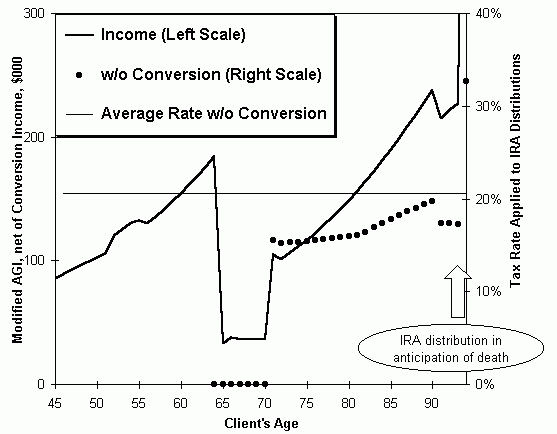
The next ten years are heavy financial sledding for Bill and Sue. They can't seem to save anything and even have to stop contributing to their pension plans while the girls are in college. Note the upward adjustment during the years the girls are in school. Their modified adjusted gross income (See Figure 1, left hand scale) increases gradually until retirement, the result of the assumed 4% wage escalation.
Income decreases upon retirement but increases after age 71 when mandatory pension distributions begin.
Sue's income drops at age 90 due to smaller Social Security benefits after Bill's death.
Income is large in the year of the second death because the remaining balance in the pension account is distributed (ref. 2).
The solid dots plot the tax paid on distributions from their IRAs and pensions (right hand scale.) During retirement, Bill and Sue will pay an average 21% rate of tax on these pension distributions.
If Bill and Sue were to elect to convert some or all of their pensions to Roth (ref. 3), the conversion income would be on top of the income shown here. Since the rate of tax increases with income, converting after retirement when other income is relatively low might produce the least tax on the conversion income.
The only times when income is below $100,000, and thus the only times that Bill and Sue are actually eligible to convert their pensions to Roth, are while they are in their forties or while retired but before required pension distributions begin.
Balance Sheet - Gradual Conversion From Age 65
By age 55, Bill's IRA and their pensions have grown to $225,000 and their home has appreciated to $220,000. Taxable investments have shrunk to $66,000.
With college behind them, Bill and Sue are able to increase their savings and, by the time they retire at age 65, their IRAs and pensions are worth $700,000, their home, now worth $500,000, is paid off and their taxable portfolio is worth $300,000. (These are future dollars.)
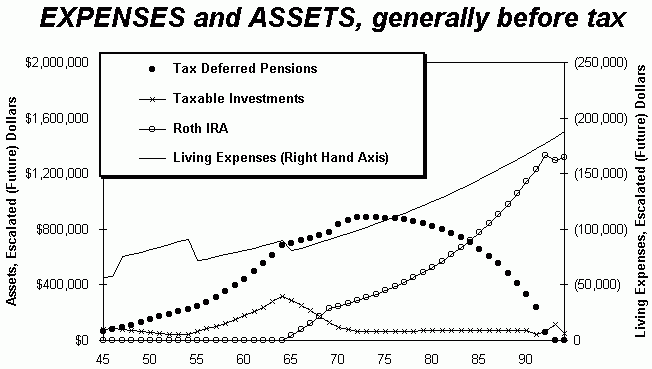
Figure 2 illustrates these statements. The solid line traces their expenses (right hand axis) and the upward jog at ages 47 - 54 reflects their college expenses. The decrease in expenses at age 65 reflects the end of mortgage payments. The gradual increase of expenses with time is the effect of inflation.
The value of their taxable investments (left hand axis) is largest at retirement. Bill and Sue have to dip into their capital after retirement to supplement other income and to pay income tax on any Roth conversions and this causes their taxable account to drop after retirement. By about age seventy in this scenario, taxable investments have shrunk to the value of an emergency fund and economic distributions are required from the tax deferred pension accounts.
The value of their pension accounts (left hand axis) doesn't grow very fast until the girls finish college since Bill and Sue cannot afford to make contributions during these years.
In this scenario, 5% of the value of their tax deferred pensions is converted to a Roth IRA each year for five years (ages 65 through 69.) Consequently, the value of their pension accounts grows only slowly from ages 65 through age 69.
From age 71 onwards, Bill and Sue take annual pension distributions equal to the larger of the required minimum distribution or the economic distribution to balance income and expenses. The reality is that the distributions will be taken for economic reasons and the value of Sue's pension accounts falls to zero about her age 92. (Remember, Bill dies about age 90. We are assuming that their estate plan has been drawn up to avoid estate tax at the first death. Some of Bill's Roth IRA may be held by the "by-pass" trust for Sue's benefit but this distinction has no practical effect on these results.)
The value of the Roth IRA (left hand axis) grows rapidly during the conversion years (ages 65 through 69.) The growth thereafter reflects the 8% investment return. Late in life, Sue's only assets are her home and her Roth IRA and she is forced to draw upon the Roth IRA for living expenses.
The value of all assets at the second death is $2.9 million, net of income tax. In an analogous forecast without conversion, the assets are worth $2.7 million. Converting to Roth increases wealth at the second death by about $200,000.
This wealth benefit is in future dollars and should be evaluated in relation to future expenses. By converting, Bill and Sue have generated additional wealth equal to about 14 months of extra living expenses. By converting, Bill and Sue have the security of additional living expenses should they live longer than anticipated or additional funds for long term care should that be necessary or additional assets for their heirs.
Converting at Different Ages
Our objective is to determine whether it is more advantageous to convert at one age as compared to another. Therefore, the above analysis was repeated assuming conversion at ages 45, 55 and 75. This required a series of forecasts at each age in order to determine the timing and conversion amount which provide the largest wealth benefits at each age. This "best" conversion strategy is shown in the table. The symbol K means thousands; i.e., $20K means $20,000.
Wealth benefits are stated both as an increase in after tax net worth at the second death and as the number of equivalent extra months of living expenses.
Age |
Conversion Strategy |
Wealth Benefit |
Estate Tax Benefit |
IRA Tax |
Below $100K |
|
45 |
$20K (30% 1998) |
$75K |
5 mo. |
small |
19% |
Yes |
55 |
$60K (4%/yr '08-12) |
$100K |
7 mo. |
$50K |
18% |
No |
65 |
$200K (5%/yr '18-22) |
$200K |
14 mo. |
$125K |
16% |
Yes |
75 |
$300K (5%/yr '28-32) |
$100K |
7 mo. |
$50K |
18% |
No |
Converting partially and gradually over several years often produces the largest benefits and that is true for Bill and Sue as well. Converting in 1998 is special because the conversion income can be spread over four years. Although the age 45 scenario is the only scenario to enjoy the special 1998 conversion rules, much the same effect is achieved by converting gradually at the other ages.
It is said that the Roth IRA is more beneficial the further you are from retirement. What the commentators mean is that conversion is more efficient at younger ages; that is, wealth benefits from converting the same amount of money are larger at younger ages. For example, converting $20,000 at age 45 produces 3 -4 times the benefit per dollar converted as compared to converting $200,000 at age 65.
However, the wealth benefits are substantial at all conversion ages and the largest benefits are not necessarily at younger ages. In this scenario, the largest benefits are obtained by converting between retirement and about age seventy.
Estate tax benefits are the extra estate tax that would be due if there were not an opportunity to make a full withdrawal of tax deferred pension balances in the year of the second death. Post death income tax offsets have been neglected.
With no conversion, Bill and Sue paid an average 21% income tax on IRA and pension withdrawals. Converting, in this example, lowers the average IRA tax rate to between 16 and 19%. In effect, Bill and Sue receive a discount for paying the income tax early and avoiding a big income tax bite at the second death.
Increased Resources over Expenses
Suppose that Bill and Sue expect to receive an inheritance, the equivalent of $200,000 today, about fifteen years hence. This inheritance will increase their taxable income after age 60 and, because of graduated tax rates, will increase the rate of tax to be paid on pension withdrawals. With the inheritance but without conversion, their investments are worth $800,000 at retirement, the average IRA tax is 29% and the value of their assets at the second death is $5.5 million net of income tax.
Age |
Conversion Strategy |
Wealth Benefit |
Estate Tax Benefit |
IRA Tax |
|
45 |
$20K (30% 1998) |
$200K |
14 mo. |
small |
27% |
$60K (100% 1998) |
$700K |
48 mo. |
$50K |
21% |
|
55 |
$60K (4%/yr '08-12.) |
$275K |
20 mo. |
small |
26% |
$280K (40%/yr '08-12.) |
$1,300K |
90 mo. |
$75K |
21% |
|
65 |
$650K (25%/yr '18-22) |
$1,400K |
99 mo. |
$75K |
22% |
75 |
$1,200K (50%/yr '28-32) |
$975K |
66 mo. |
$100K |
32% |
Wealth benefits are much larger than in the earlier scenarios. This illustrates that benefits generally increase when something happens to increase resources (e.g., an inheritance or improved investment return) without a corresponding increase in expenses or when living expenses decrease without a change in resources. Conversion benefits the affluent, the thrifty and the savvy investor. A financial disaster would have the opposite effect and would lower benefits.
These scenarios also illustrate that the conversion strategy to achieve the best wealth benefits changes as the underlying assumptions change. For example, Bill and Sue should convert a larger fraction of their pensions if they are confident that they will be receiving an inheritance.
The Younger Individual
Non financial considerations can play an important role in the conversion decision. This is especially true for the younger investor who probably has other priorities which are more pressing than making an extra retirement contribution.
The younger investor has the opportunity of delaying conversion and should focus on the incremental benefits of converting now as compared to waiting until retirement. These incremental benefits are generally small and are often negative. Delay reduces planning uncertainty by foreshortening the financial forecasts on which the conversion strategy is based and protects against the legislative risk that the rules will be changed in ways that make the Roth IRA less attractive.
For all these reasons, it is often best to wait to convert until your income is low unless you are sure that your income will be increasing (the inheritance scenario) or you are convinced that our legislators will repeal the conversion opportunity.
Endnotes.
1. For example, Lingane, P.J., Should You Convert to a Roth IRA? AAII Journal, November 1997.
2. Taking a full distribution of IRAs and other tax deferred pensions immediately before the second death reduces estate tax and can increase the amount of money received by the heirs of $1 - 3 million estates. This pre-death distribution has the further practical effect of allowing us to compare alternate scenarios on the basis of the after tax value of the assets at the second death.
3. A married couple may convert a traditional IRA to a Roth IRA if they file a joint tax return and if their modified AGI is less than $100,000. Modified AGI is the usual AGI less the conversion income plus any IRA deduction, plus any interest on EE Saving Bonds and plus any foreign income exclusions. Qualified plans must be rolled over to a traditional IRA before they can be converted to Roth and such rollovers can usually only occur when changing jobs or upon retirement. These practical considerations may make it impossible to convert at some of the ages indicated.
_________________________________
| Bill & Sue, aged 45 years | ASSUMPTIONS as of 1/1/98 |
||||
| Personal Data | Date of Birth |
Age |
Death |
Yr of Death |
|
| Client | 1/1/53 |
45 |
90 |
2043 |
|
| Spouse | 1/1/53 |
45 |
94 |
2047 |
|
| Pension Beneficiary | |||||
| Pension Distribution Life Expectancy Method | Both Lives Refigured | ||||
| Tax Filing Status | MFJ |
Exemptions |
2 | ||
| Income | Client |
Spouse |
|||
| Social Security Benefits, current dollars | $9,600 |
from 2018 |
$9,600 |
from 2018 |
|
| Wages, non qualified stock options | $45,000 |
thru 2017 |
$45,000 |
thru 2017 |
|
| Pensions, escalated at wage rate | $0 |
from 2018 |
$0 |
from 2018 |
|
| Pension escalation rate and survivor benefit | 1.020 |
50% |
1.020 |
50% |
|
| Business & Other Income subject to SE tax | $0 |
from 2001 |
thru 2001 |
||
| Other Taxable Income, not subject to SE tax | $0 |
from 1999 |
$0 |
from 2000 |
|
| Other Income, net of tax | $200,000 |
from 2013 |
thru 2013 |
||
| Living Expenses, net of taxes | $42,000 |
currently |
$42,000 |
from 2017 |
|
| plus Charitable Contributions | $1,000 |
thru 2050 |
|||
| plus Annual Gifts (non deductible) | $0 |
from 2003 |
thru 2005 |
||
| plus Real estate, personal property taxes | $2,000 |
||||
| plus Home Mortgage | $115,000 |
7.5% Interest Rate |
20 years remaining |
||
| plus Money Manager Fees | 0.00% |
on the first $100,000 |
plus 0.00% thereafter |
||
| plus Non Deductible Expenses, net of tax | $15,000 |
from 2000 |
thru 2007 |
||
| plus Pension Contribution, % of wages | 10% |
Up to |
$30,000 |
||
| plus Non Deductible Roth Contribution | $ 0 |
||||
| Assets | |||||
| Life Insurance | Death Benefit $0 |
Cash Value $0 |
|||
| Homes & Personal Property | $225,000 |
||||
| Investments and Pensions | Presently |
Minimum |
Maximum |
Allocation |
|
| IRAs, 401k, 403b | $50,000 |
||||
| Equities & Variable Annuities | $0 |
$0 |
unlimited |
50% Stocks |
|
| Taxable Bonds | $0 |
$0 |
unlimited |
0% Munis |
|
| Municipal Bonds | $0 |
$0 |
unlimited |
||
| Cash (US Treasury Securities) | $75,000 |
$50,000 |
$100,000 |
||
| Roth IRA Conversion Rate | 0% in '98 |
plus 0% /yr. |
from 2018 |
thru 2022 |
|
| External Assumptions | |||||
| Growth Rate of capital assets, incl. dividends | 8.00% |
Div. Yield |
2.00% |
||
| Growth Rate of Pensions and Roth IRA | 8.00% |
thru 2000 |
8.00% thereafter |
||
| Treasury Bond Rate | 6.00% |
||||
| Taxable Bond Rate | 6.50% |
||||
| California Municipal Bond Rate | 4.50% |
||||
| Inflator for Living Expenses & Social Security | 1.030 |
||||
| Inflation Factor for Wages | 1.040 |
||||
| Inflation Factor for Personal Residence(s) | 1.040 |
||||
| Inflation Factor for Real Estate Tax | 1.020 |
||||
| Estimated Tax Payments, % of AGI | 18% |
||||
| Tax Payment applied from prior years | $ 0 |
||||
_________________________________
This article is not a complete discussion of the issues nor is it a full recitation of state and federal tax laws and regulations. Review your personal circumstances with your tax adviser before contributing or converting to a Roth IRA.
Home
| Newsletter | Taxpayer Assistance and FAQs | Roth IRA